Jet Ski Licence In Queensland: Who Needs What Before Riding
Queensland's jet ski licence rules come from Maritime Safety Queensland, and they sit in three parts: who must hold a licence, what a supervised unlicensed driver may do, and the speed, distance and equipment rules that apply to everyone on the water.
Short answer
To operate a jet ski in Queensland you must hold a PWC licence plus a recreational marine driver licence, or a PWC licence plus a commercial marine licence as master, or have a licensed person on board able to take immediate control. Trident, Poseidon and Jet Ski Tours Brisbane all state no licence is needed on their guided tours.
Queensland treats a jet ski as a personal watercraft, and the rules that govern it sit with Maritime Safety Queensland. The licence question is only one part of it. Registration, lifejacket levels, speed and distance limits, child seating and the smooth water boundaries all attach to the machine and the rider, whether that rider spent months earning a licence or joined a guided tour ten minutes after a briefing. This page lays out the rule set item by item, then shows exactly what the Brisbane tour operators say about licences so the two halves of the question never blur together.
| Item | The Rule As Stated | Who It Applies To |
|---|---|---|
| Licence to operate | PWC licence plus recreational marine driver licence, or PWC licence plus commercial marine licence as master | Every operator of a jet ski in Queensland |
| No licence held | A licensed person on board, able to take immediate control in case of trouble | Unlicensed riders under supervision |
| Supervised driver passengers | Only the supervising licence holder may ride along | Unlicensed drivers |
| Registration | All personal watercraft must be registered | Every jet ski |
| Lifejacket | Level 50 required in all water categories | Everyone on board |
| Night riding | Navigation lights required at night | Every jet ski |
What Licence Do You Actually Need To Drive A Jet Ski In Queensland?
To operate a personal watercraft in Queensland you must hold a PWC licence plus a recreational marine driver licence, or a PWC licence plus a commercial marine licence as master, or have a licensed person on board who is able to take immediate control in the case of any trouble. Maritime Safety Queensland words it exactly that way, and no fourth route appears on its personal watercraft page.
The first route is the one most recreational riders take: a PWC licence on top of a recreational marine driver licence. The second matters for people who work on the water, because a commercial marine licence held as master pairs with the PWC licence instead. The third is the route that catches attention, because it does not require the driver to hold anything at all, provided a licensed person is on the same craft and able to take immediate control if trouble starts. That is a real option under the rule as written, not a loophole invented by tour companies, and it is worth understanding before reading what the operators say further down this page. The licence, in other words, attaches to the person driving, and the three routes differ only in which combination of licences that person holds.
Two consequences follow. All personal watercraft must be registered, whoever drives them, so a licensed friend lending a registered ski does not escape that requirement. And the supervised route carries its own limits, set out in the next section, which narrow who may ride along.
| Licence Route | What The Rider Holds | Passenger Conditions |
|---|---|---|
| Standard recreational | PWC licence plus recreational marine driver licence | Passengers per the seating rules |
| Commercial | PWC licence plus commercial marine licence as master | Passengers per the seating rules |
| Supervised, no licence | Nothing, with a licensed person on board able to take immediate control | Only the supervising licence holder |
No licence fee, exam structure or test detail is published on the page this guide draws from, so none appears here. For the practical question of renting without a licence, the piece on renting a jet ski without experience covers the tour side of that decision.
Do You Need A Licence For A Guided Jet Ski Tour In Brisbane?
Every guided tour operator covered here states on its own pages that no licence is needed. Trident's tour pages each carry the line "No licence or experience needed". Poseidon's and Jet Ski Tours Brisbane's booking pages say no licence is required on the guided tours. Jet Ski Tours Brisbane's own website also carries contradictory licence wording elsewhere, so that operator's answer comes with a caveat: confirm with the operator before booking.
That is the honest summary, and the distinction matters. The operators' statements are theirs, printed on their pages, and this guide attributes every line to the operator that wrote it. Maritime Safety Queensland's page sets out who must hold a licence in the state; it says nothing on its face about guided tours, and no legal instrument for the tours appears in any verified source here, so none is claimed. The two statements sit side by side without one being bent to explain the other.
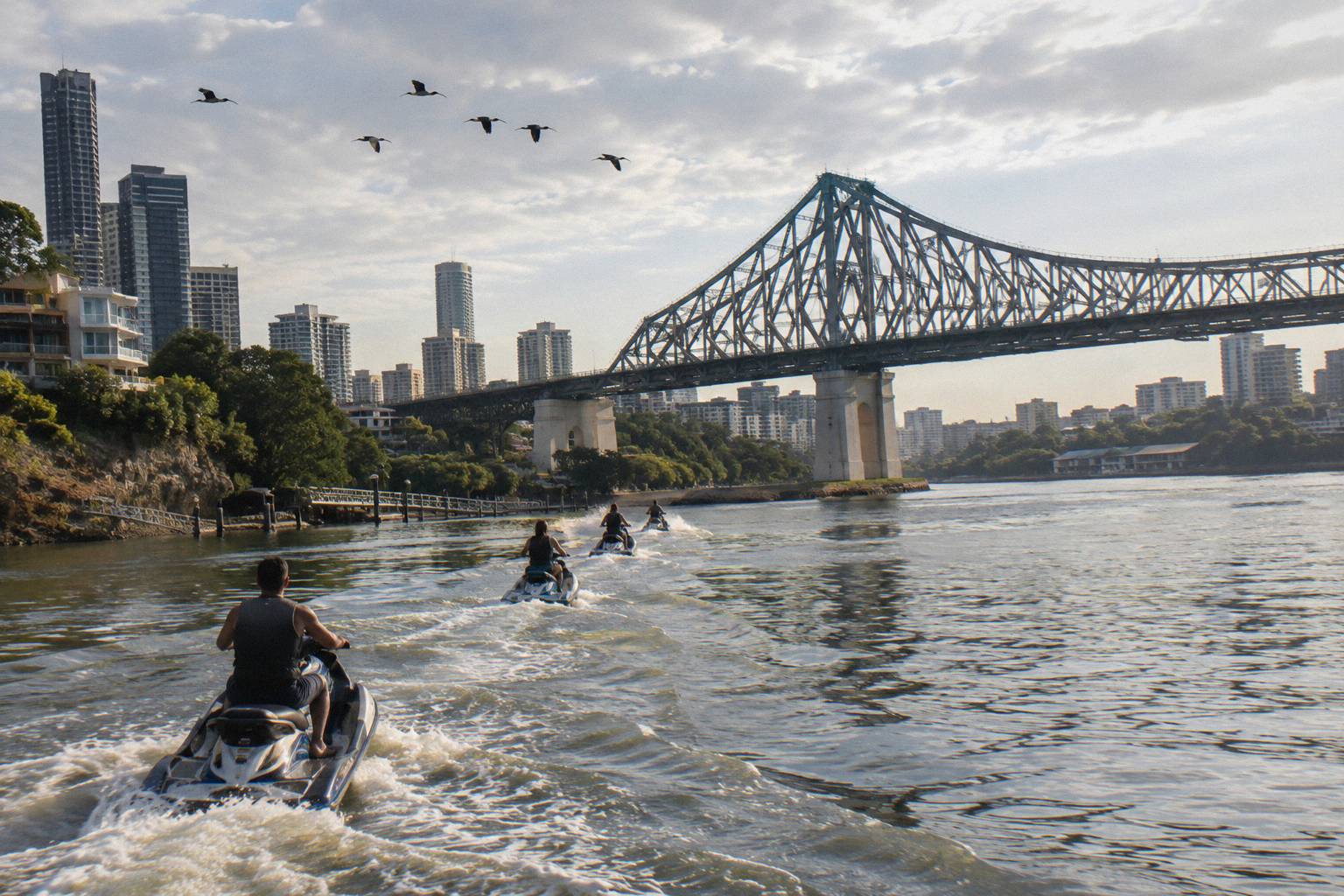
The practical reading for a visitor is simple. If the goal is to ride a jet ski on the Brisbane River or in Moreton Bay without first obtaining a Queensland licence, the guided tours are the stated route, and each operator says so itself. The Trident sunset tour is one example: a 2 hour river tour, one departure a day at 4.00pm October to March and 3.00pm April to September, from A$299 per ski with up to 2 riders, meeting at Rivergate Marina in Murarrie. Its page carries the no licence line like every other Trident tour page. If the goal instead is to drive your own or a hired ski unsupervised, the licence routes in the section above apply in full, and the guide on jet ski hire in Brisbane, self drive or guided works through that comparison.
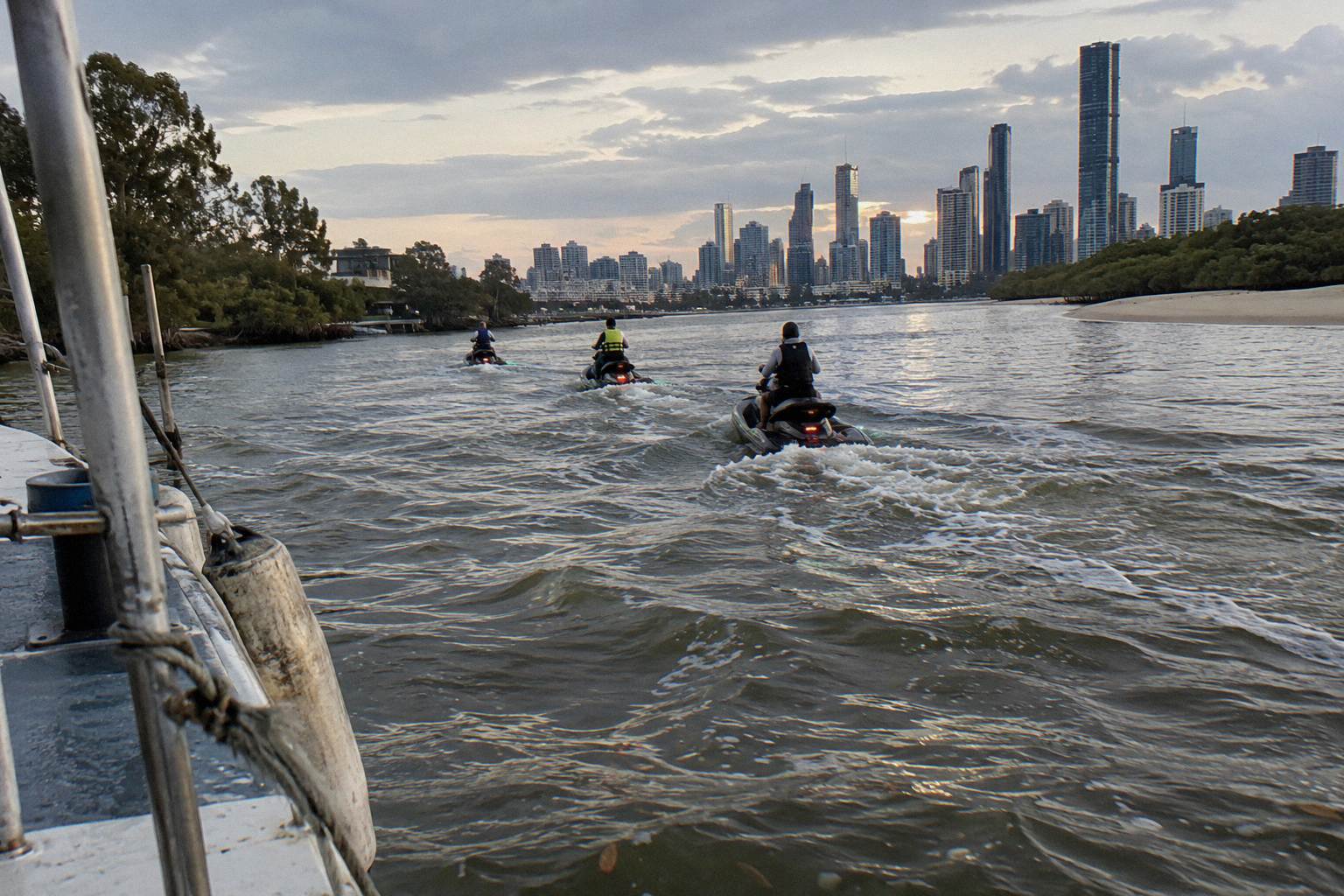
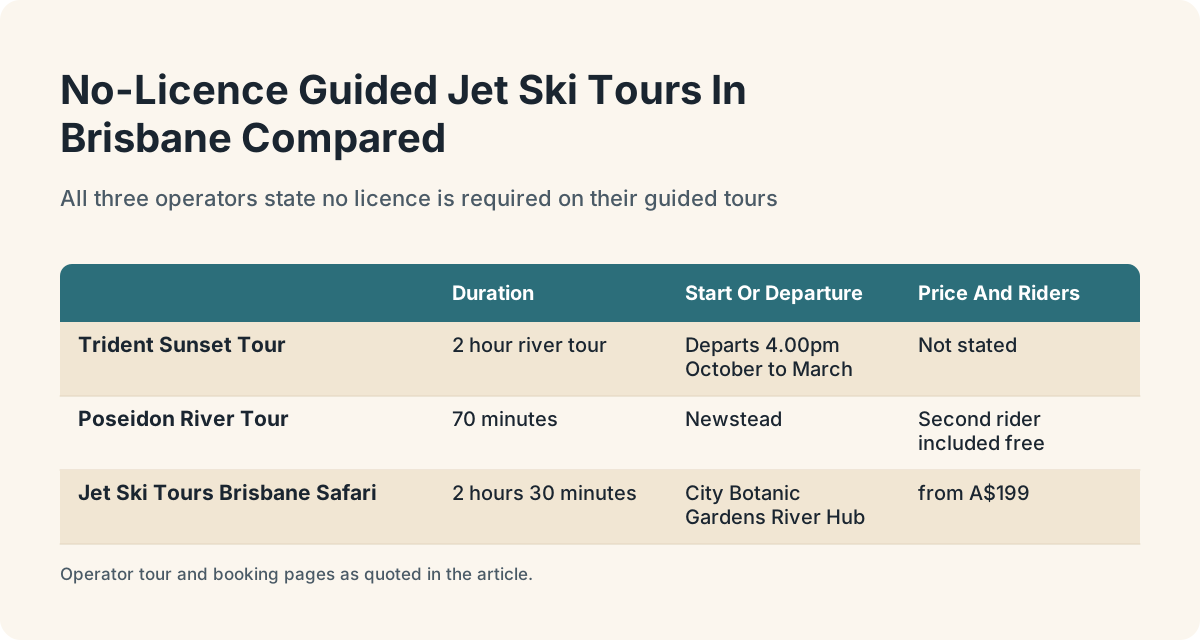
Among the tours that state no licence is required, the choices differ more in format than in paperwork. The Poseidon river tour runs 70 minutes from Newstead with one ski for up to two riders, the second rider included free, and free tour photos; its booking page shows a 5.0 rating. The Jet Ski Tours Brisbane safari runs 2 hours 30 minutes from the City Botanic Gardens River Hub out to Moreton Bay, from A$199 per person twin share at the operator's RRP, with a solo rate for solo riders. Each states no licence is needed on its booking page, and each includes a guide, a safety briefing and lifejackets, so the licence question resolves the same way on both.
| Operator | Licence Statement | Where It Appears | Caveat |
|---|---|---|---|
| Trident Jetskis | "No licence or experience needed" | Each tour page | None stated |
| Poseidon | No licence is required on the guided tours | Booking page | None stated |
| Jet Ski Tours Brisbane | No licence is required on the guided tours | Booking page | Operator's own site carries contradictory licence wording; confirm before booking |
The Jet Ski Tours Brisbane caveat deserves one plain sentence: its FAQ and one tour's inclusions carry wording that reads differently from its main tour pages, so the reader should confirm with the operator directly rather than rely on either line alone. Its FAQ page, at jetskibrisbane.com.au/faqs, is the operator's own page on the question.
What Are The Rules For A Supervised Unlicensed Driver?
A supervised unlicensed driver may not carry passengers other than the supervising licence holder, and that supervisor must wear the kill-switch lanyard while the unlicensed driver rides. Maritime Safety Queensland states both conditions together, which means the supervised route is narrow by design: one licensed person, one unlicensed driver, no one else on the craft. Break either condition and the arrangement does not match the rule as printed.
This is where friendly plans usually come unstuck. A licensed adult supervising a teenager cannot also take a younger sibling as a third person on the same ski, because the rule names the supervising licence holder as the only permitted passenger. Swapping drivers mid-session changes who must wear the lanyard, since the supervisor holds it whenever the unlicensed driver is riding. These are operator-independent rules: they come from the same Maritime Safety Queensland page as the licence routes and apply to any jet ski in the state.
The seating rules for children run alongside this. The child sits behind the driver, passengers must reach the foot wells with both feet, and the number of people on the craft must equal the number of seats, with under-12s no longer counting as half a person. For the guided tours, the operators state their own age minimums: Poseidon and Trident both put drivers at 16 and over and passengers at 7 and over, and the Jolly Roger at Sandstone Point lists passengers at 8 and over. For Jet Ski Tours Brisbane, the operator's own pages give inconsistent minimum ages, so ask the operator before booking rather than working from any single figure.
If sharing a ski is part of the plan, the article on two people riding one jet ski sets out the per-operator weight and seating details, and the guide on jet ski age limits in Queensland collects the printable age figures in one place.
What Speed And Distance Rules Apply To Every Jet Ski Rider?
Reduce to no more than 6 knots within 60 m of people in the water, anchored or moored boats, structures, boat ramps, jetties, pontoons, a bathing-reserve boundary or the shore, and keep 30 m from any other moving ship or slow to under 10 knots. In coastal waters, freestyling or wave jumping is restricted to beyond 200 m of shore where homes sit within 100 m of the shoreline.
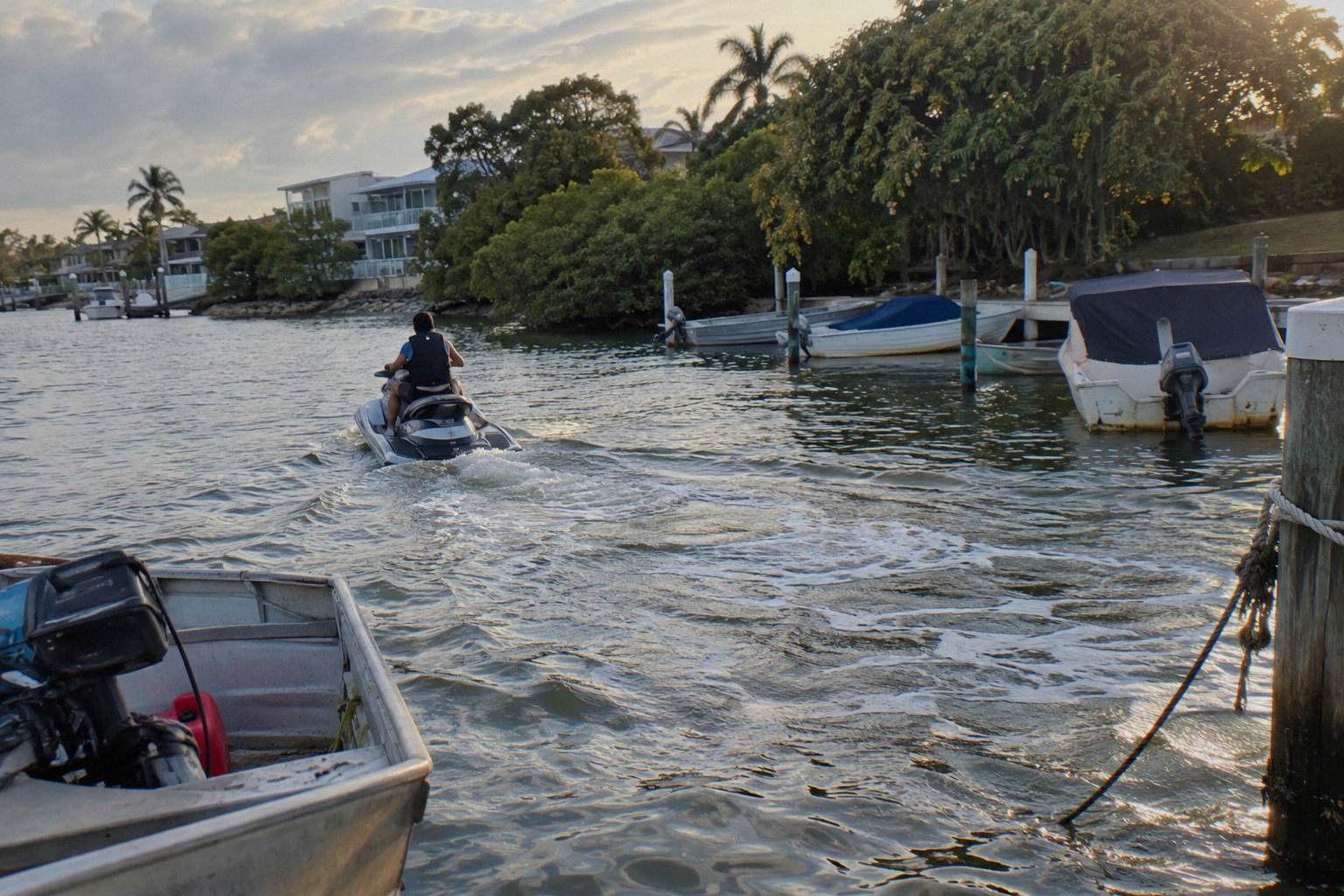
These apply to every rider, licensed or not, guided or solo. The 6 knot rule has printed exceptions: the shore distance does not apply on a narrow waterway under 120 m wide if you transit in a near-straight line near the centre or in a marked channel, and waterskiing or towing has its own carve-out. The 30 m rule for other moving ships also carries exceptions for approved aquatic events or where keeping the distance would endanger someone. No Brisbane River specific speed limit appears in any verified source here, so none is stated; the statewide figures above are the ones Maritime Safety Queensland publishes. Everything else covered here is indexed on Brisbane Jet Ski Tours.
On a guided tour the guide sets the line and the briefing covers the day's conditions, so the practical instruction comes from the operator. The rules above are the backdrop every rider in the state shares, and they explain the shapes a guided ride takes: straight-line transits, tidy spacing between skis, and slowing near anything anchored or moored.
| Rule | The Figure | Applies Within Or Around |
|---|---|---|
| Slow to 6 knots | No more than 6 knots | 60 m of people in the water, anchored or moored boats, structures, ramps, jetties, pontoons, bathing-reserve boundary or shore |
| Other moving ships | Keep 30 m or slow to under 10 knots | Any moving ship |
| Freestyle and wave jumping | Beyond 200 m of shore | Coastal waters where homes are within 100 m of the shoreline |
What Are The Lifejacket, Registration And Night Rules?
A level 50 lifejacket is required in all water categories, all personal watercraft must be registered, and navigation lights are required at night. Maritime Safety Queensland states all three without exceptions by water type, which is why the tour operators list lifejackets in their inclusions: Trident includes a level 50 lifejacket, Poseidon includes lifejackets with its briefings, and Jet Ski Tours Brisbane lists PFDs alongside its 15 to 20 minute safety briefing.
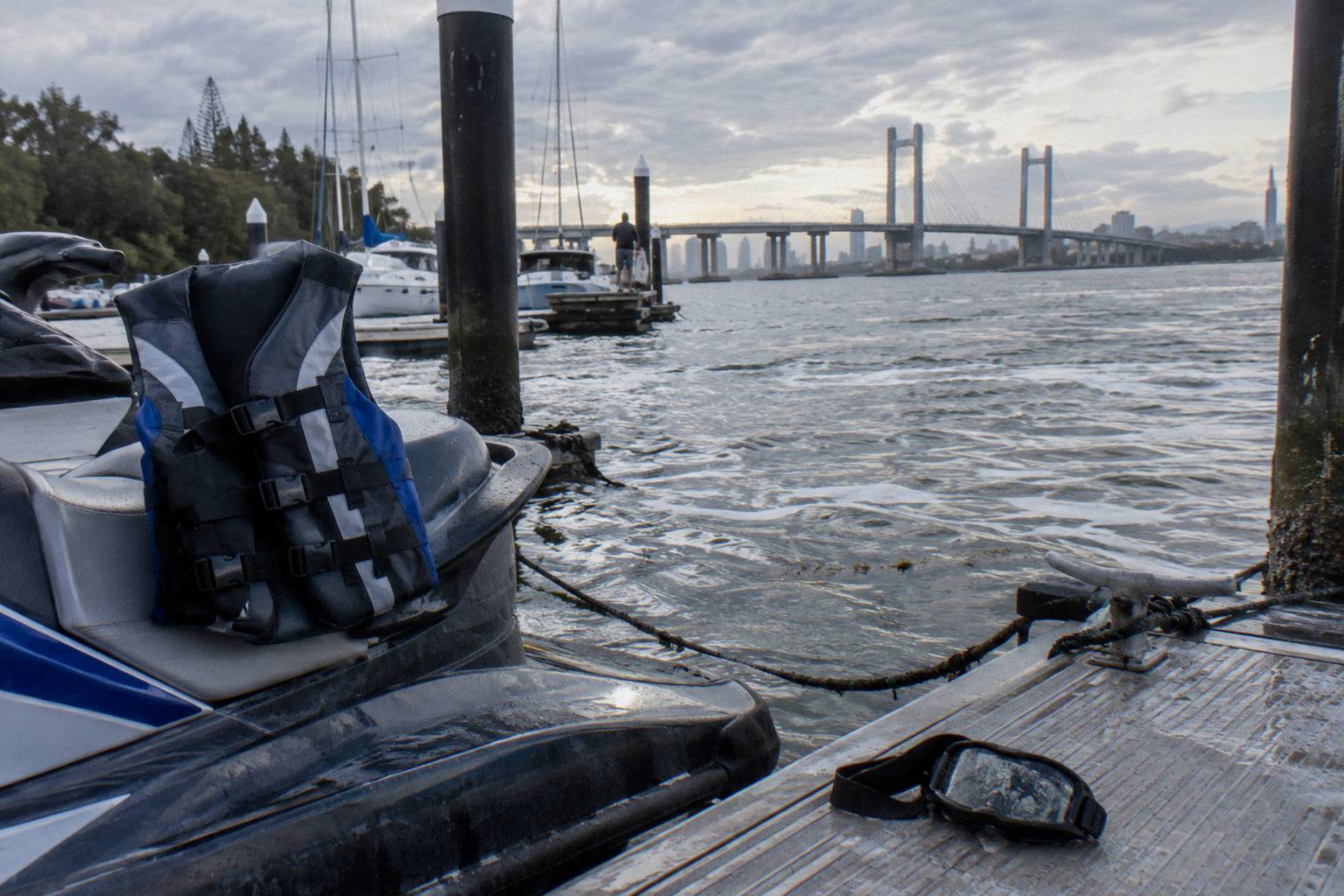
The level 50 requirement is the one that touches riders directly, because it sets the minimum standard for the jacket on your back regardless of where in the state the ski is ridden. It is not a smooth-water-only rule and not a bay-only rule; it reads "in all water categories". The tour inclusions line up with it: Trident includes goggles as well, Poseidon lists a life jacket, safety briefing and guide, and Jet Ski Tours Brisbane adds dry bags to its kit.
Registration is the quieter of the three, because on a guided tour the machine belongs to the operator and the burden sits there. For anyone riding under the supervised route on a friend's ski, the registration requirement still applies to that craft. Night riding is the third plank: navigation lights are required at night, and none of the Brisbane tours covered here advertises a night departure, with the evening option being the Trident sunset tour, which leaves at 4.00pm October to March and 3.00pm April to September. Riders who want to see the river after dark can read whether you can ride a jet ski in the Brisbane River for the river-specific picture.
What Are Smooth Waters And Where Does Brisbane Sit?
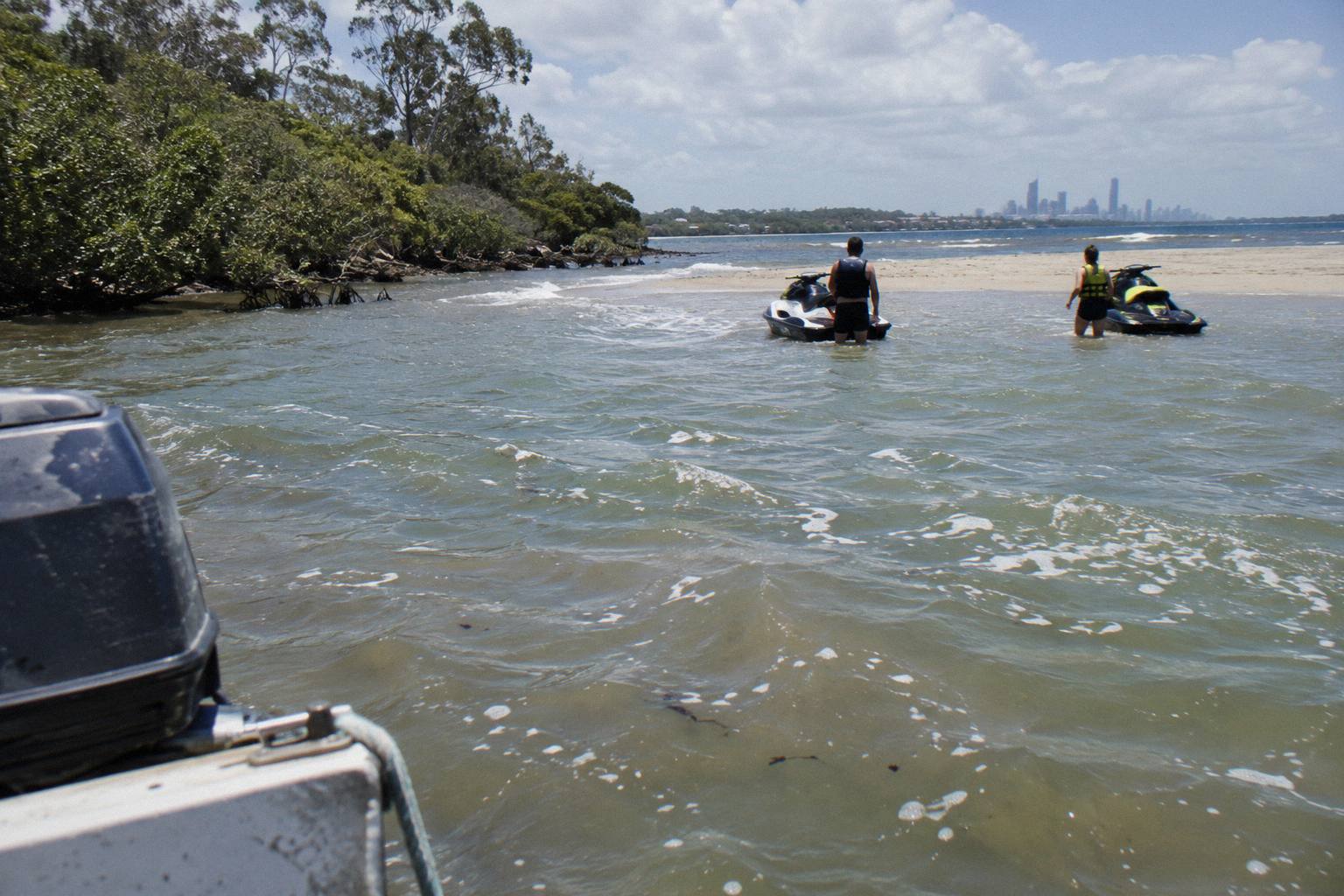
Maritime Safety Queensland defines smooth waters as rivers, creeks, streams and lakes, waters within breakwaters or revetments, and waters within half a nautical mile from land within partially smooth water limits. Under the Brisbane smooth water limits, the Brisbane River and the bay west of Moreton and Stradbroke islands sit inside smooth or partially smooth water, and the open ocean side sits outside it.
The category matters because water classifications feed the wider rule set rather than standing alone. The Brisbane limits are drawn between named points, set out on the official smooth and partially smooth water limits page: smooth waters run inside a line from Cleveland Point to Amity Point along the western shore of North Stradbroke Island, plus the area inside Bribie Island, and partially smooth waters run from Skirmish Point on Bribie to Comboyuro Point, along the western shore of Moreton Island to Short Point, to Amity Point and Cleveland Point. That is the official geometry, and it puts every tour route covered on this site, the river trips from Newstead, Murarrie and the City Botanic Gardens, and the bay trips out toward Moreton Island, inside the smooth or partially smooth categories.
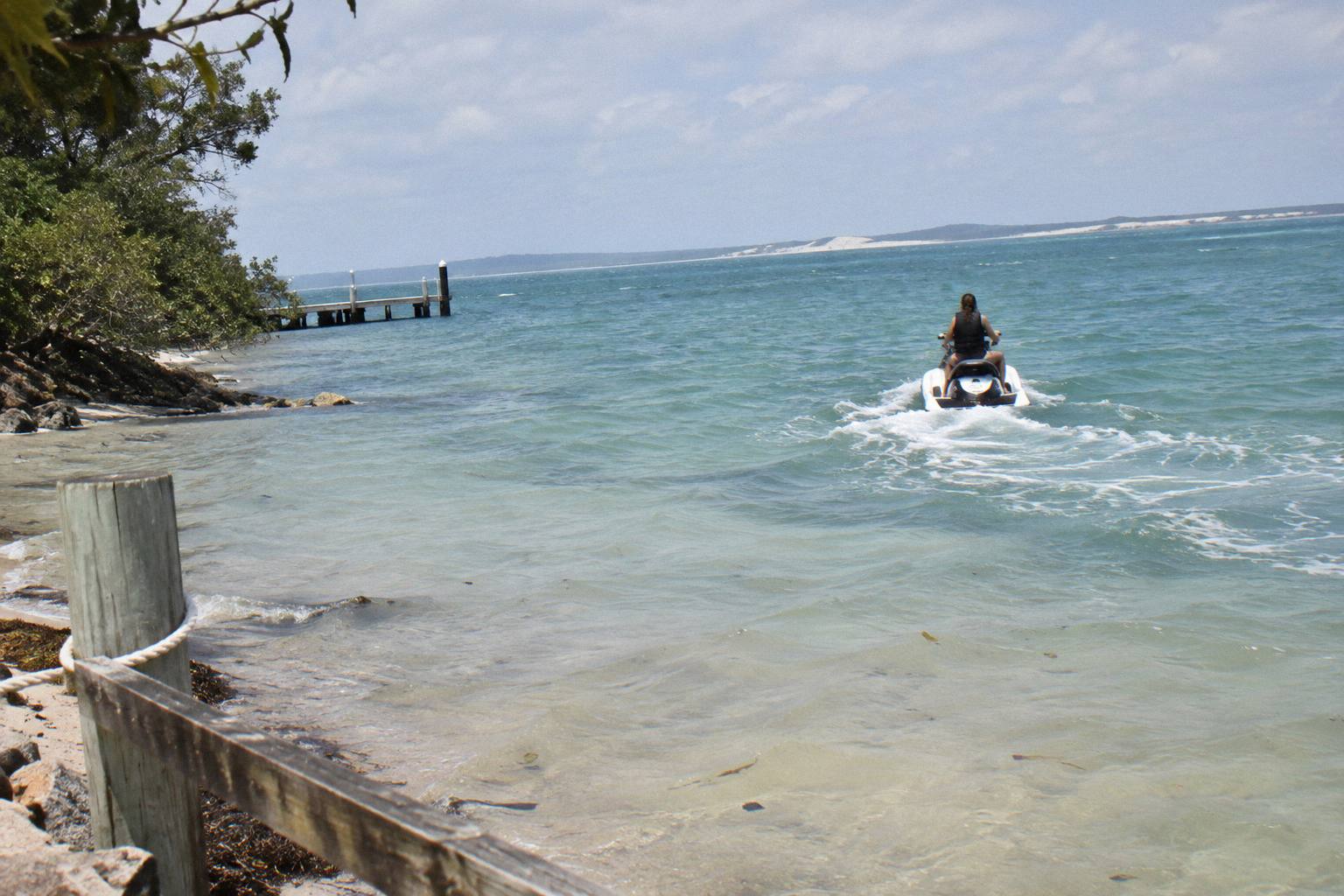
For the marine park side of the bay, Queensland Parks states that "operating vessels (including jet skis) is largely unrestricted in the marine park", with go slow and no-anchoring areas and marine mammal approach distances to follow. In go slow areas a vessel must not navigate on the plane, and jet skis cannot do motorised water sports there: driving other than in a straight line, including circles, weaving, surfing or jumping wave and wash, towing a person, or not taking the most direct route between two places. The park's visiting safely page carries those rules, and specific marine mammal approach distances for jet skis are not on that page, so none is printed here.
| Water Category | Definition As Stated | Where The Brisbane Tours Sit |
|---|---|---|
| Smooth waters | Rivers, creeks, streams and lakes; waters within breakwaters or revetments; within half a nautical mile from land inside partially smooth limits | Brisbane River; inside Bribie Island; inside the Cleveland Point to Amity Point line |
| Partially smooth waters | The declared partially smooth limits for the area | Bay waters from Skirmish Point to Comboyuro Point, western Moreton Island to Short Point, Amity Point, Cleveland Point |
| Outside | The open ocean side | Beyond the declared lines; no tour covered here runs there |
What Trips People Up When Checking Jet Ski Licence Rules?
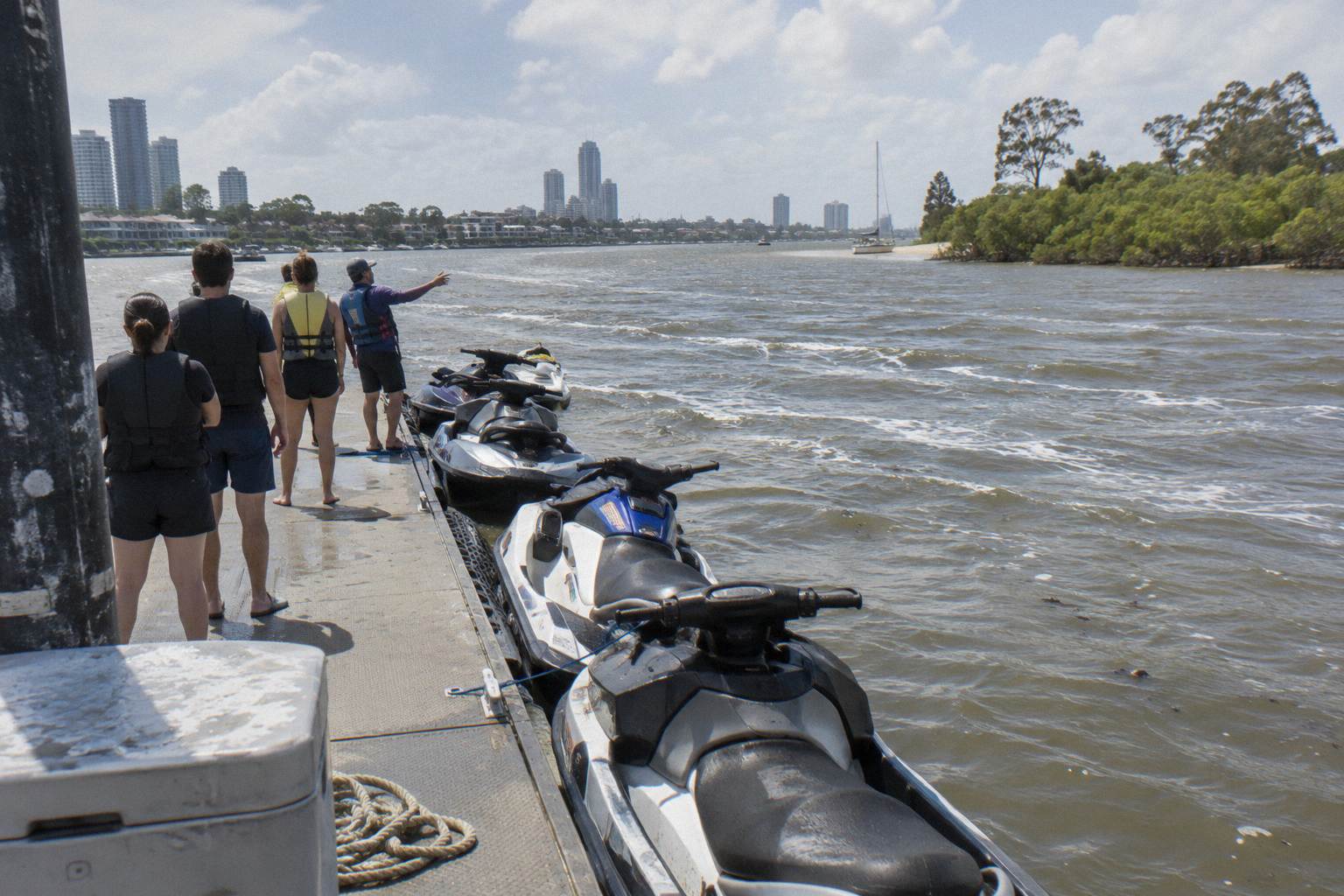
The common mistakes are treating operator marketing as law, assuming the supervised route allows a full ski of passengers, and reading one page of a conflicting website as the whole answer. Trident, Poseidon and Jet Ski Tours Brisbane all state no licence is needed on guided tours, but those are operator statements, not a regulation. The supervised route permits only the supervising licence holder as a passenger.
The first mistake shows up in forum answers and search snippets: someone repeats "tours are exempt" as if a statute were quoted. No verified Queensland page states the legal instrument the tours run under, and this guide does not either. The operator statements are real and printable because the operators wrote them; the leap from "the operator says no licence is needed" to "the law says so" is where the error creeps in. Jet Ski Tours Brisbane's own pages carry contradictory licence wording, which makes the confirm-with-the-operator step part of the booking rather than an optional extra.
The second mistake is planning around the supervised route as a family arrangement. One licensed supervisor, one unlicensed driver, nobody else: that is the rule as printed. A third rider, whoever they are, takes the arrangement outside the wording. The seating rules add the child-behind-the-driver and foot-well requirements, and the under-12 change catches people who learned the old half-person convention.
The third mistake is reading a single page of a site that disagrees with itself. Jet Ski Tours Brisbane's tour pages say no licence is required while its FAQ and one inclusions list read differently, so the workable answer is to confirm with the operator at booking. The same discipline applies to prices elsewhere on this site: the details sit in the guide to jet ski prices in Brisbane, always with the operator's stated basis attached. And for the basic framing question of whether the river is open to jet skis at all, the answer is in can you ride a jet ski in the Brisbane River.
If the licence-free path is the one you want, the Jet Ski Tours Brisbane Blast is the short option on the river: 1 hour 30 minutes, Story Bridge to Gateway Bridge, from A$149 per person twin share at the operator's RRP, with a solo rate for solo riders, and its booking page states no licence is required. Availability sits on the booking calendar, and check availability shows the current sessions.
One last habit worth keeping: ask the operator the licence question in your own words when booking. Trident, Poseidon and Jet Ski Tours Brisbane each state their position, and a written answer at booking beats a paraphrase read weeks earlier. Brisbane Jet Ski Tours collects the statements so the comparison is quick, but the operator's own reply is the one that counts on the day.
Common Questions About Jet Ski Licence Queensland
Do Guided Jet Ski Tours In Brisbane Require A Licence?
No, according to the operators themselves. Trident's tour pages each say "No licence or experience needed", and Poseidon's and Jet Ski Tours Brisbane's booking pages state no licence is required on the guided tours. Jet Ski Tours Brisbane's own site carries contradictory licence wording elsewhere, so confirm with that operator before booking.
Can Someone Without A Licence Drive If A Licensed Rider Is On Board?
Yes, under the Maritime Safety Queensland rule that permits an unlicensed rider with a licensed person on board who is able to take immediate control in the case of any trouble. The supervising licence holder must wear the kill-switch lanyard while the unlicensed driver rides, and the unlicensed driver may carry no passengers other than that supervisor.
What Licence Combination Does Queensland Require For A Solo Rider?
A PWC licence plus a recreational marine driver licence, or a PWC licence plus a commercial marine licence as master. Those are the two combinations printed on the Maritime Safety Queensland personal watercraft page; the third route is the supervised arrangement, which is not a licence at all.
Do All Jet Skis Need To Be Registered In Queensland?
Yes. Maritime Safety Queensland states that all personal watercraft must be registered, whoever operates them and whichever licence route applies. On a guided tour the ski belongs to the operator, so the registration requirement sits with the operator.
What Lifejacket Is Required On A Jet Ski?
A level 50 lifejacket is required in all water categories, with no exception stated for smooth waters or the bay. The tour operators include lifejackets in their tours: Trident lists a level 50 lifejacket, Poseidon lists a life jacket with its safety briefing, and Jet Ski Tours Brisbane lists PFDs with its briefing.
Can You Ride A Jet Ski At Night In Queensland?
Navigation lights are required at night under the Maritime Safety Queensland rules. None of the Brisbane tours covered here advertises a night departure; the evening option is the Trident sunset tour, departing at 4.00pm October to March and 3.00pm April to September.